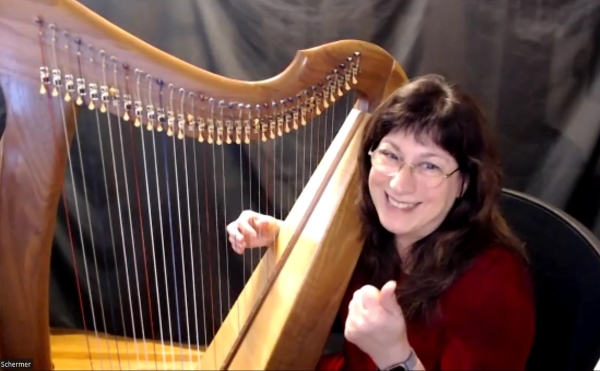
To read about workshops and classes that Verlene
teaches, click here.
To read about workshops currently offered online visit
her calendar.
The workshops listed below were presented on Zoom in
2020 - 2022 and are available as video links with workshop
handouts. Click on a title to read about each class. Then
use the button below the description, and you'll
receive the handouts and video link via email within 2 or
3 days!
You’ll learn tunes in 7/8,
5/8, 9/8 (not a slip jig!), 4/4 and 2/4 from Armenia,
Bulgaria, Greece, Macedonia, Romania, Serbia, Turkey, and
Ukraine. We’ll watch and listen to each tune on YouTube,
some that show the dance, and all with singing. You’ll be
provided with lever/harp arrangements that can also be
played on piano, with lyrics for the first verse in
phonetic spelling, and chord names on top of the melody.
In addition, classical and finger style guitarists will be
provided with arrangements of the tunes in guitar notation
and tablature. Singers can use the “harp and vocal”
arrangements to sing along. These tunes are fun to play
and can be added to your therapeutic repertoire to pull
out when someone requests something from this part of the
world. If you are not a therapeutic musician, you can
enjoy playing these tunes to experience a bit of the
flavor of Eastern Europe!
Use
this button to order your video link and handouts!
Music for Memory Care -- $30
This workshop is open to all
musicians, particularly those who play in Assisted Living
or Memory Care units. You will be able to add to your
repertoire of music that is not only appropriate for this
demographic but is also sure to touch a memory deep within
that brings joy and light. You’ll find they will sing
along, whether or not they know all the lyrics, and
amazingly, they can remember these lyrics far easier than
they can remember what they had for lunch. That’s probably
true for us all! You’ll get handouts in lead sheet form to
many of the songs I perform at several facilities where my
concerts are regularly scheduled. Singers, harpists,
guitarists – all are welcome!
Use
this button to order your video link and handouts!
Holiday
Harp Therapy--$30
Whether you are playing a
lot of extra harp gigs during the holidays this year, or
simply needing a way to de-stress, this workshop will
cover some simple de-stressing techniques to help you get
through the busy holiday season. We’ll cover breathing and
relaxing exercises to start your harping day, how to avoid
repetitive injuries, and some lovely harp warm-ups that
you’ll enjoy playing even at the start of a gig! This is
great therapy using your harp, for yourself or others,
whether or not you are a performing harpist.
Read comments from
participants:
"Thank you very much for the
holiday harp therapy workshop. So useful at this time, and
those patterns are quite beautiful and magical! I'm always
inspired by your workshops!"
"I appreciate the patterns
and ideas because I find them ethereal and freeing --
there's just more color, and I hear more things to go
along with that, and it's just... peaceful. This is what
you need in the recovery room."
Use
this button to order your video link and handouts!
Here
We Go A-Caroling! -- $30
Our larger harps may be too
large to go door to door, so we’ll focus on the small
harps we can actually carry and how to create simple
accompaniments to several Christmas Carols and Songs. A
Christmas Caroling book PDF will be provided with several
tunes in harp and voice friendly keys. If you don’t have a
small harp, you’re welcome to attend with your large one!
Use
this button to order your video link and handouts!
Change
Up Your Groove -- $30
We’ll take a few traditional
songs and apply different time signatures, or different
rhythm patterns to change up the groove! We’ll try several
on for size and hear how each gives the tune a new feel.
Changing 3/4 to 4/4 or visa versa is one way to do this,
but we can also apply Swing, Jazz Waltz, Bossa Nova,
Calypso, Reggae, even Middle Eastern rhythms. I’ll provide
lead sheets for several tunes we can choose from, and
we’ll try playing them with each of these grooves.
Use
this button to order your video link and handouts!
Intro to Improvisation -- $30
Although this workshop is
primarily for lever or pedal harp, other instruments are
also welcome! Improvisation can be used in many settings:
providing music behind meditation; playing bedside music;
waiting for your cue to start processional music, or
simply for creative expression! We’ll cover some basic
concepts of improvisation, and apply some simple tools for
both right hand and left hand (melody and accompaniment)!
Your handouts will include these concepts and tools and
also some easy chord progressions you can use in any
application. Read comments from participants:
"Your example improvisations
were beautiful!! The patients where you play are so lucky
to have you visit!"
"I personally liked the pace
of the class even though I couldn't always keep up because
I can barely play inversions, ha ha! But I still "got"
what was going on in the context of the ideas you were
teaching."
Use
this button to order your video link and handouts!
Simple
But Beautiful! -- $30
With Verlene's guidance,
you will learn how to arrange tunes for harp that are
simple but beautiful! Watch as the class co-creates
arrangements in real-time during the two-hour
workshop. Handouts will be provided that cover how to
choose chords, how to arrange a playable left-hand
part, and some simple tools for adding interest.
You’ll also be provided with a packet of traditional
melodies that the class chose from. Verlene uses
Sibelius in a shared screen to demonstrate how the
ideas can be implemented. You'll get a PDF of all the
arrangements created during the workshop. Read
comments from participants:
"Thank you for the list of
"things to try" -- I will make use of that when I find my
arrangements are too boring."
"I want to thank you -- I
was one of those who skipped all the theory classes and
went straight to the playing, and what we did today was
helpful because it was very analytical. But for those of
us who are more right brain, I can see how the building of
muscle memory will make it more intuitive."
Use
this button to order your video link and
handouts!
Beyond
the Basics! --$30
With Verlene's guidance,
you will learn to apply chord extensions and
substitutions, along with rhythmic elements from
modern styles to co-create "jazzy" arrangements in
real-time during the two-hour workshop. Handouts are
provided, including chord substitution charts, chord
extension charts, and traditional tunes that can be
arranged. Verlene uses Sibelius in a shared screen to
demonstrate how the ideas can be implemented. You'll
also get a PDF of the arrangements created during the
workshop.
Use
this button to order your video link and
handouts!
Celtify
Your Tunes! -- $30
Even Celtic tunes can sound
more “Celtic” with some Celtic ornamentation and phrasing.
Those who have a classical music background will know
terms like grace note and mordent. There are variations
more common in Celtic music that can help your tunes sound
more Celtic than classical. We’ll use simple lead sheet
arrangements of traditional Celtic as well as a few pop
tunes and a few classical tunes and “Celtify” them with
the birl (also called “treble” or “same note triplet”),
the cut, the roll, and more! Some of these ornaments are
used in bagpipe music, some are common in fiddle music,
and all are fun to apply to harp, piano, or guitar! In
addition, we’ll apply some common Celtic phrasing and
rhythmic elements.
Use
this button to order your video link and
handouts!
Express
Your Heart! -- $30
Although any
instrumentalist and even vocalists can take this
workshop, special attention will be given to
playing expressively on harp. You’ll learn how to
play with dynamics, phrasing, and fluidity so that
your music seems to come straight from the heart!
We’ll cover how to modify your existing
arrangements whether written out or learned by ear
to increase expressive effectiveness. Read
comments from participants:
"Thank you Verlene for a
really helpful and interesting workshop today! I was
inspired to put several of your suggestions into practice
today and I felt good about the time I spent with my harp
this afternoon. I was able to slow down and focus on a
couple of small problem sections and this gave me a sense
of accomplishment. One thing that I've never tried is
recording myself. So that's my new challenge for this
coming week."
"Thanks for all your
wonderful classes. I have enjoyed them!"
Use
this button to order your video link and
handouts!
Jump On
In! -- $30
Playing harp in a jam
session can be tricky – you have to first figure out
what key the tune is in, then figure out what to play
– chords? Bass patterns? Melody? Harmony? Also, you’ll
learn how to recognize when a tune returns to the A
part or goes on to the B part (or verse and chorus),
and how to find your way back in if you get lost… All
of these and more will be presented in this workshop,
as well as jam session etiquette and a few other tips.
Use
this button to order your video link and
handouts!
Playing
Well With Others -- $30
Playing harp with other
instruments can be great fun! But learning about the
other instruments in your band or ensemble will help
you to find your sonic space within the group.
You’ll get a handout that lists each instrument’s
range, key, and technical limits. You’ll also get
tips on how to play along when songs step out of the
key. During the workshop, you’ll get to play along
with some audio examples of bands and ensembles to
apply the concepts covered in the handouts.
Use
this button to order your video link and
handouts!
Vocal
Improvisation for Therapeutic Musicians -- $30
In
this class, which is open to all musicians
(even if you don’t consider yourself a
singer!) The use of the human voice in
therapeutic music can be an effective way to
connect and share empathy. We’ll cover how to
create a soothing tone of voice, how to be
expressively empathetic, and how to use
patterns and variations to stay within a key
or mode if you are singing a cappella. We’ll
do a bit of ear training to find anchor notes.
If you are an instrumentalist as well, you can
accompany your vocal improv, and there will be
chord progressions to apply that you can
transpose to any key. Read a comments from a
participant:
"This was such a fantastic
workshop -- I learned SO much!! Many thanks for taking on
this project. You really offereed a comprehensive learning
experience and opened new avenues for singing to me!!"
Use
this button to order your video link and
handouts!
Aeolian Mode: Natural and
Harmonic Minor -- $30
In
this class, which is open to all
instrumentalists you'll learn all about
the natural minor scale (which is the same
as the Aeolian Mode) and the harmonic
minor scale (which is an altered Aeolian
mode). Each has a unique quality and mood,
and these qualities would be worth
including in your therapeutic music
repertoire. You'll learn 4 tunes in each
mode, and also get instruction on how to
improvise using natural and harmonic
minor. You'll get a review of how to find
each mode in any key, and you'll get some
improvisation ideas as well. Lead sheets,
as well as simple harp arrangements (which
can also be played on piano) and guitar
tab are provided in the extensive
handouts.
Use this button to order your
video link and handouts!
Waltz Around the World --$30
Waltzing is a fairly
universal dance and where there is a dance, there is music
to go with it! The waltz is based on 3/4 time, and can
range from Oom pah pah to rolling eighth notes, to the
syncopated jazz waltz. They're fun to play and are great
to add to your therapeutic music repertoire. You will
learn traditional waltzes from several countries as well
as a few modern tunes from pop, country, and jazz. You'll
also learn how to improvise using the rhythm and chord
changes of each tune. Lead sheets, as well as simple harp
arrangements and guitar notation and tab will be provided.
Use this button to order your video link
and handouts!
Singing
with the Harp -- $30
In
this class, you will learn how to coordinate
singing with playing harp. We'll use a few
well-known tunes as well as a few of the
requested songs from a January 2023 concert:
"Life Stages: Songs & Stories for those who
care for the elderly." If you'd like to hear
some of those in advance, the concert is on YouTube.
In this workshop, you'll learn some secrets for
keeping your voice expressive and fluid while
playing a solid accompaniment on harp. You'll
get lead sheets plus two-hand patterns, in
addition to a brief "how-to" on special lever
settings.
Use
this button to order your video link and handouts!
Cool
Chords & Groovy Rhythms Series
This
series can be taken as a four-part series or taken
as individual classes. The first class covers
chord extensions, and is an opportunity to not
only learn what is in each extended chord but also
how to move easily from chord to chord in a chord
progression. The second class covers rhythms used
in modern music styles, and you’ll get to play
chord progressions using a variety of rhythmic
patterns. The third class applies the cool chords
and groovy rhythms from the first two classes to
improvisation and playing from lead sheets “on the
fly.” And the fourth class applies it all to
arranging by group consensus, using a few
different traditional tunes. There is no need to
purchase the book, “Cool Chords & Groovy
Rhythms, but if you would like a copy you can
order one here.
Here are some comments from past
participants of the Cool Chords & Groovy
Rhythms workshops:
“I
just wanted to thank you for this workshop! I learned
sooo much!!! I found that your book (which I have had
for more time than I want to admit) is basically like
gold for me. Thanks for sharing your knowledge.”
"Verlene, wanted to send out
a big thank you for doing this workshop. This is such
good information, and you present it so
thoroughly. And as a bonus it was so much fun to
see everyone online, old friends and new."
"Thank you for the class,
Verlene. I’ve printed out the book and look forward to
following up with all this information. Being
classically trained, as a pianist, which is good in some
ways, but not others, this gives me permission to
explore and discover without feeling like I’m playing it
wrong! I’ll just think to myself - Verlene said
it’s okay!"
"Verlene - this was pretty much my idea of
heaven!!!!!!!!!!!!! Thank you so much for the
wonderful class!!!!!!!!! I learn so much from
you!!!!!!!!!!!! I so hope this class continues!
LOVE IT!"
"Awesome again - it really makes my brain
work, and takes my mind of of everything else that is
going on!” "Very informative and easy format to
follow."
"It was exactly what I was looking for. I
also learn best by hearing, so in a way I understand
about cool chords, but I am not familiar with them,
and so being lazy, I too often fall back on the
same-old, same-old. I will never in this lifetime be
able to learn this information from a book, but doing
it this way (and more than once) will allow me to gain
the familiarity with chords so that I can just start
adding them in. Finally, release from the dreaded
triad chord, HOORAY!"
Part 1: Cool Chords--
$30
In this class, you’ll learn how to find those cool
added notes that are “beyond and between” the
three notes of the triad. We not only locate the
notes, but practice playing them through chord
progressions so you can learn how to keep the
common tones and move smoothly and melodically
from chord to chord.
Use this button to order your video link
and handouts!
Part 2: Groovy Rhythms
-- $30
In this class, you’ll learn how to swing,
syncopate and rock a tune. We use chord
progressions and insert a number of the chord
extensions learned in Part 1, but if you are
comfortable enough with 7th and 9th
chords, Part 1 is not a pre-requisite.$25
Use this button to order your video link and
handouts!
Part 3: Cool & Groovy Improv
-- $30
In this class I cover how
to approach improvisation using the chords and
rhythms learned in the first two classes. Those
who have been using the book or have attended
previous versions of the Cool Chords and Groovy
Rhythms workshops should be fine jumping in here
without taking Parts 1 and 2. We also cover
playing “on the fly” using lead sheets, both as
accompaniment to a melody instrument or singer,
and as an improvised arrangement playing both
melody and chords.
Use this button to order your video link and
handouts!
Part 4: Cool & Groovy
Arranging
-- $30
In
this class, I cover how to use chord substitutions
to come up with more interesting arrangements of
traditional tunes. With my guidance, participants
apply chord extensions and substitutions, along with
rhythmic elements from modern styles to co-create
"jazzy" arrangements in real time during the two
hour workshop. This is a great follow up class to
the first two parts in the Cool Chords & Groovy
Rhythms series, but it can also be taken without
having attended the morning class. Handouts include
chord substitution charts, chord extension charts,
and traditional tunes that can be arranged. I use
Sibelius in a shared screen to demonstrate how the
ideas can be implemented and the participants will
volunteer ideas to try out. You also get PDFs of the
arrangements created during the workshop.
Use this button to order your video link and
handouts!
The
Sing-Along Harper -- $25
If you've ever wished you could play
harp along with group sing-alongs, this class is
for you. You can also use the finger picking
patterns for accompanying melody instruments. This is
either for those who have bought the book "The
Sing-Along Harper," and are looking for tips and
help with the patterns, or for those who just want
to pick up some new tools! If you have not purchased the book, and
would like to, you can order a hard copy or a PDF
version here.
Here
are some comments from participants:
"I enjoyed the class
and learned some gems. I've sung and played
folk guitar for ever but have found it a challenge
to accompany myself singing with the harp because
I'm so focused on getting the harp part
correctly. I've jammed on my harp with friends
who play guitar so can see the chords by looking at
their guitars but find that I use the same
patterns. I'm excited to practice and learn
new accompaniment patterns from your class."
"I liked learning the bits of music theory that you
shared. I'm familiar with the I, IV, & V chords
and relative minors for most keys and know how to
transpose, but didn't know what makes a chord a
minor and the relation of half and whole steps
within a key. Also I don't know much about how
to tell the difference between the modes. So
thank you for those insights!"
Use this button to order your video link
and handouts!
How to Play "D" Blues --
$30
In this workshop, you'll learn how
to set your levers in order to play the blues
in the key of D, which requires more than just
the notes in the major scale, and how to
improvise blues solos. You'll learn both
"rhythm guitar" harp techniques and "lead
guitar" phrasing.
Here are some comments from
participants:
“That
was great! I learned lots of things about playing
blues, and will go practice them. I can see that I
don't need to come up with improv "melody" but can
just mix or repeat licks. You give a very
clear presentation that's easy to follow. I'd been
scared by the 7ths and 9ths but you made it clear
and I liked hearing what they sound like in all
the places you used them. I caught also the idea
of damping-and-strumming. Also that you can omit
notes in the RH that are already used in the LH --
big help! I feel like, with what I learned today,
I can soon have my harp sounding like the blues!”
“Thanks
Verlene - this was just terrific!I have always been able to hear the
blues, but have never known for sure just what is
going on technically there. Great tips and
explanations. In fact, I'm trying to relearn the
piano keyboard (no levers, you have to remember to
hit those pesky black keys) so I'm going to use
your element composition there are well. Then
maybe I can understand the blues on two
instruments!”
“Awesome
class so full of new (for me)
information! I learn more about music
theory with each class that helps me understand
the structure of the music that I have been
playing for many years. I'm excited
to explore new place on my harp and to make my
music more interesting!”
“Thank
you. This was packed with information.”
“Thank
you so much!!My head
is full of new ideas and places to go with my harp
and brain!!!”
“Thank you for EVERY BIT of this. You are a really fine teacher. Excellence and empathy are a winning combination.”
Use
this button to order your video link and handouts!
Improving the Improv --
$30
This
workshop is for harp, or for any instrument!
A bit of structure can help improvisational
playing sound like a well-conceived
composition rather than just aimless
wanderings... In this workshop we'll talk
about form, mood, melodic motifs, and
intention -- and how to use these tools when
improvising on the fly! You can improve your
improvisational playing by understanding
what effect your choices will have on the
listener. These choices include modes, chord
progressions, melodic contour, harmonic
content, and rhythmic elements. These
elements can work together to create a sense
of place, and an intentional journey from
one place to another. This is a great
opportunity for therapeutic musicians to add
to your toolbox, as well as any musician who
would like to improve their improvisational
skills.
Use this button to
order your video link and handouts!
Virtual
Ensemble Video Production -- $25
In this workshop, you will be given step by
step instructions on creating virtual duets or larger
ensembles either with other musicians, or with
yourself! Starting with tips for mapping out the
arrangement, then on to the logistics of recording
each part, and finally, how to put it all together
using video software (I uses Cyberlink PowerDirector
but most programs have the same features), with real
time demonstrations of each step. Here are a few of
the videos I had produced during 2020:
Use this button to order
your video link and handouts!
Playing by Ear -- Template
for Melody (part 1a) Major keys -- $30
In
this workshop you'll learn how to use the major scale
as a template that will help you remember melodies and
play them by ear on your harp.There will be numerous
examples that will help to build your skill and
confidence, working through the “3 D’s” of playing by
ear. This can be applied to songs you have known all
your life, or songs that you are hearing for the first
time.
Use this button to order your video link and
handouts!
Playing by Ear -- Context for Chords
(part 1b) Major keys -- $30
In
this workshop, you'll learn how to add
chords to any melody. You'll learn the
function of each chord, and also how to
recognize what chords the melody suggests.
There will be several examples of
well-known melodies, as well as some
lesser known, and some completely unknown
melodies.
Use
this button to order your video link
and handouts!
Playing by Ear -- Template for
Melody (part 2a) Minor keys and
Modes -- $30
In
this workshop you'll
learn
how to alter the major scale to
recognize when a tune is in
Mixolydian mode, Aeolian mode, or
Dorian mode, and when it is in a
Harmonic Minor key.
Use this button to
order your video link and handouts!
Playing by Ear -- Context
for Chords (part 2b) Minor keys and Modes -- $30
In
this workshop, you'll
learn
how chords function in Mixolydian mode, Aeolian
mode, and Dorian mode, as well as in a Harmonic
Minor key. There
will be several
examples of well-known melodies, as well as some
lesser known, and some completely unknown
melodies.
Use this button to order your video link
and handouts!
Major Modes Immersion -- $25
In
this workshop, the three major modes, Ionian,
Mixolydian, and Lydian will be presented with
tunes from the book as well as from the handouts
for the class that participants can play
together during class (along with the video), as
well as tips on improvising and composing in
these modes. The book is available as a
physical book or a PDF.
Use this button to order your video link
and handouts!
Minor Modes Immersion --
$25
In
this
workshop, the three minor modes, Aeolian,
Dorian, and Phrygian will
be presented with tunes from the book as well as
from handouts for the class that participants
can play together during class (along with the
video),
as well as tips on improvising and composing in
these modes. She will also present Locrian mode
during this workshop. The
book
is available as a physical book or a PDF.
Use this button to order your video link and
handouts!
Altered Modes Immersion --
$25
In
this
workshop, the altered modes: Harmonic Minor,
Melodic Minor, and Phrygian Major will
be presented with tunes from the book as well as
from handouts for the class that participants
can play together during class (along with the
video),
as well as tips on improvising and composing in
these modes. The
book
is available as a physical book or a PDF.
Here
are some comments from participants in the
Modes Immersion series:
Thank you for the
workshop and all the materials. I am really
enjoying playing my harp again and experiencing
your gentle and extremely knowledgeable
approach. I am finding inspiration from you with
my teaching. thank you!
I really enjoyed the workshop last Friday
evening. The materials and explanations were fun
and informative. Can’t wait for more!
I really like all of these altered modes! Very
exotic and haunting... and fit with my likes in
world music.
I
especially want to say thanks for the doc
on ‘What about modes in other keys?” I
got myself into a tangle when I tried to
work those out after the major modes
workshop. This clarifies it
beautifully.
Use this button to order your video link and
handouts!
Arranging for Harp Ensemble
-- $25
In
this workshop, you will learn how to make an
arrangement that will keep all of your ensemble
members happy! Whether they are multi-leveled
players or all at the same level, and whether
all on one size harp or on multiple size harps.
I used Sibelius to demonstrate how a simple
traditional tune can be developed in a number of
ways for a variety of harp ensembles. Handouts
for the class include PDFs of each of the harp
ensemble arrangements demonstrated during class.
Use this button to order your video link and
handouts!
Improvise Around the
Christmas Tunes -- $25
In
this
workshop, you will learn some simple tricks to
improvise using the Christmas tunes you already
play! You'll learn how to improvise
introductions and interludes "on the fly," how
to add ornaments to "decorate" your tunes, and
how to play fills and modify your melodies for
an improvisational verse. You'll receive
handouts of a few simple arrangements of
Christmas tunes that will be used as examples,
and you'll be able to play along to apply each
improvisational element during the workshop, but
there are also handouts that you will be able to
use to apply all that you learn to the tunes
that are currently in your repertoire, whether
they be holiday tunes or "all season" tunes!
Here are some comments from
participants:
I really enjoyed
today’s workshop. You gave so much information,
I’m sure I can manage a few of those tips right
away.
Thank you so much for today's workshop. I
learned so much and am eager to put it into
practice!
I'm eager to take more workshops from you next
year!
Use
this button to order your video link and handouts!
Sibelius Music Notation Tips
& Tricks -- $25
In
this workshop, which is open to all
instrumentalists and vocalists, you will learn
how to put your music into clear and easy to
read notation using Sibelius. Although the
professional version of Sibelius is pricey,
there is a free
version of Sibelius called Sibelius
First, and it has all of the
features you will need for creating solo harp
arrangements, guitar tab, piano/vocal music,
lead sheets, or ensemble music up to 4
instruments. As a music publisher, I have used
Sibelius to transcribe and layout music for 61
publications to date (see
books), and I'll share several shortcuts
and tricks using the shared screen in Zoom along
with close ups of her computer keyboard.
Use this button to order your video link and
handouts!
The Practice of Practicing --
$30
This
is
open to all musicians. If you have felt that no
matter how much you practice, the improvement is
either slow or non-existent, this gentle class
will give you steps to improve your practicing
practice... You'll have a step by step approach
to learning a new piece, troubleshooting an
in-progress piece, and polishing a learned
piece. You'll also get tips on how to use your
current works in progress to create warm-up
exercises that will build some much needed
muscle memory.
Use
this button to order your video link and
handouts!
Vocal Mechanics -- A
Look Under the Hood -- $25
This
workshop
is
open to all singers, both experienced
and novice. In this workshop, I will
reveal the inner workings of the
instrument we all carry within us, and
give exercises along
with visualizations and tips for
developing
and improving your vocal skills. I will
also make use of a few simple songs that
can be sung together to experience the
use of diaphragmatic breathing, vocal
registration, and vocal timbre. The
book and CD by this title are available
both as a physical book and CD and as a
PDF book and mp3s. You can order one here.
Use
this button to order your video link and
handouts!
Playing to Heal --
$25
This
is open to all musicians, but will
focus on application to harp.
Understanding how melody, rhythm,
harmony, and dynamics affects our
physiology will give us tools in our
music choices, interpretations of
music, and music improvisations in
order to be effective in a healing
setting such as hospice or hospital,
or even in our own private space!
We'll explore a few studies and use
the findings to play music in a
variety of interpretations, altering
the tempo, rhythm, harmony, and
dynamics to experience a variety of
feelings and physical responses. We'll
also improvise over chord progressions
with a focus on melodic content in
order to more fully understand how to
play music that soothes.
Use
this button to order your video link and
handouts!
Intention in
Improvisation -- $30
This
workshop
is open to all musicians, particularly
those interested in playing in a
healing capacity such as hospice or at
bedside, or playing for guided
meditation, or guided visualization --
or even for your own personal
meditation. It is important to
understand that it is not only what we
play but also how we play that will
have impact on the listener's
physiological and emotional response.
This workshop will cover some of the
elements that result in physiological
responses, as well as how the emotions
and intentions of the musician inform
these elements. This will be applied
by improvising to visual stimuli and a
guided visualization during the class.
Here are some comments from
participants:
Thank you so much for the informative and enriching
workshop! I loved every minute of
it.I admire you and see you as a
role model. Thank you.??
Thanks
for such a grand workshop. The
information was helpful and
your teaching style is great.
Use this button to order your video link
and handouts!
Cross-Strung Harp
Boot Camp --
$25
This workshop is for
those with cross-strung harps (7/5
stringing) who would like to learn
tips on fingering and chord voicing
and how to adapt lever/pedal harp
music and piano arrangements to
cross-strung harp. Fingering charts
and chord voicing examples will be
provided along with some music to play
together.
Although my cross-strung books are not
required for the workshop, if you are
interested, here are links to a few
books you might find useful: Jazz Chord Voicings,
Jazz Chord Finder,
Cross-Strung Traditional Tunes with a Twist,
and Cross-Strung
Traditional
Tunes with a Twist for Small Harp,
which fits Brother Benjamin or
Esabelle harps.
Use
this button to order your video link and
handouts!
Harp Technique for
Harp Newbies --
$25 Whether
you're new to harp, or just want to
brush up on the things you should know
about harp technique, this first class
will cover posture and hand position,
placing concepts with 2, 3 and 4
fingers, linked placing, repeated notes,
playing two hands together, interval
fingering, triad chord fingering (root
position and first and second
inversions), blocked and broken chords,
thumb crossing, and finger crossing.
These are the techniques covered in her
Harp
Newbies lesson book, (level 1).In
addition, you'll learn a fun surprise
harp trick that will require an item you
may have in your home -- you'll
learn how to prepare when you order this
workshop! Use this button to order your video
link and handouts!
Harp Technique for
(Not Quite) Harp Newbies --
$25 This
class will cover the techniques
presented in her (Not
Quite) Harp Newbies lesson book
(level 2). These include playing with
dynamics, rolling chords with 2, 3 and 4
notes in one or two hands, flipping
levers on time, thumb slides, glissando
(in both directions), and grace notes.
There are fewer things to cover, but we
will need ample time to get a really
good start on building the muscle memory
for each!In
addition, you'll learn a fun surprise
harp trick using your tuning key if it
is not coated with plastic, or another
object -- you'll learn how to prepare
when you order this workshop!
Use this button to order your video
link and handouts!
Harp Technique for
(No Longer) Harp Newbies --
$25 This
class will cover the techniques
presented in her (No
Longer) Harp Newbies lesson book
(level 3). No need to be in the third
level book to begin to develop muscle
memory for these techniques! These
include finger slides, double glissando,
p.d.l.t. (playing near the soundboard),
harmonics, damping and slap bass,
mordents, cut, birl, (or treble),
trill, turn, tremolo, and bisbigliando.In
addition, a fun surprise harp trick
usingjust
your two hands -- no preparation needed!
Use this button to order your video link
and handouts!
Figuring
Out Fingering --$30
There isn't only one way to
finger a particular tune, but there are
particular things you should consider
when choosing your fingering. In this
workshop, you'll learn some of the logic
behind fingering, using some
particularly challenging passages of
music. You'll learn tools for figuring
out the fingering that is best for you,
and that will help you play more
accurately and fluidly. Here is a
comment from a participant:
"Your 'Figuring Out Fingerings' workshop was
very helpful! Prior to this workshop, if I
was handed a piece with no fingerings, I
didn't even consider trying to learn it. I
only practiced pieces that had fingerings
and brackets provided because I had very
limited ability to figure out the fingering.
Now I have a little less fear and a little
more confidence!"
Use
this button to order your video link and
handouts!
Relative Modal Modulation --
$25
In
this workshop you’ll learn how to move
from one mode to another within the same
key signature. This is a good music skill
to use in therapeutic music or in playing
to enhance guided visualizations. You’ll
learn reliable chord progressions and
transitions that will help to establish
each new mode, and will learn how to
determine which mode to mode to transition
to according to situations that will be
presented during class.
Use
this button to order your video link and
handouts!
Tonic Modal Modulation --
$25
In
this workshop you’ll learn how to move from
one mode to another with the same tonic note
(the note the scale starts on.) This will
require lever changes, and you'll need to
use a harp that has levers on every string.
We'll be staying within the keys that can be
played on harps tuned in Eb, Bb, F, or C.
This is a good class for really grasping the
layout of each mode. We'll use a few modal
tune sets to practice getting levers set for
each new mode in addition to some
improvisation that moves from one mode to
another.
Use
this button to order your video link and
handouts!
Basic Ear Training
-- $30 In
this workshop, open to all
musicians, you'll
start with matching pitches, then move
to intervals, and then on to phrases
that include steps, skips, larger leaps,
and chord patterns. Each section will
include instructions and demonstrations,
tips and concepts to help you identify
and match what you hear. You will
participate by filling in your answer
sheets (handouts provided ahead of time)
for each set of examples that Verlene
will play off camera on four different
instruments (harp, keyboard, guitar, and
violin). At the end of each section, she
will show the answer key so you can
check your answers. Use
this button to order your video link and
handouts!
Advanced Ear Training
-- $30 In
this workshop, open to all
musicians, open
to all musicians. In this workshop, you
will be presented with more advanced
sequences as well as chord identification.
As in the Basic Ear Training workshop, you
will participate by filling in your answer
sheets (handouts provided ahead of time)
for each set of examples that Verlene will
play off camera on four different
instruments (harp, keyboard, guitar, and
violin). At the end of each section, she
will show the answer key so you can check
your answers.
Use
this button to order your video link
and handouts!
Harp Chord Intensive
-- Triads & Sevenths --
$25
workshop, you
will have an opportunity to really
drill those chords in root position
and inversions, as well as
"root-five-octave" patterns. You'll
learn how to "keep the common tone"
and move to the nearest inversion
with a set of chord progressions.
You'll also learn how to easily add 7s
to your chords. If you need some
practice getting from chord to chord,
this workshop will give you some great
strategies for making it come second
nature! Use
this button to order your
video link and handouts!
Lead-Sheet
Caroling --
$25 This
workshop
will cover how to make an
arrangement on the fly using lead
sheets. Although it applies to any
lead sheet the focus is on Christmas
music for this workshop. You’ll get
a PDF copy of the booklet “Christmas
Songs and Carols in Harp and Voice
Friendly Keys," in addition to
handouts on how to figure out what
notes are in the chords that are
given. The Jazz Chord Formulas
handout will help guide you through
the jazzier arrangements you might
find in a Christmas fake book.
Whether you’ll be playing background
music, or accompanying Carolers,
this workshop will help prepare to
play for any Christmas holiday
event!
Use
this button to order your
video link and handouts!
Therapeutic Guitarist --
Improvising in Major Modes --
$25 This
workshop is
open
to guitarists with a fingerstyle or
classical background, particularly those
interested in playing in a healing
capacity such as hospice or at bedside,
or playing for guided meditation, or
guided visualization. In this class
you’ll learn how to improvise in the
three major modes: Ionian (the “major
scale”); Mixolydian; and Lydian.
Handouts will include notation, guitar
tablature, as well as diagrams that show
where the scale degrees can be found on
the first 5 frets of the guitar. Use
this button to order your
video link and handouts!
Therapeutic Guitarist --
Improvising in Minor Modes --
$25 This
workshop
is open
to guitarists with a fingerstyle or
classical background, particularly
those interested in playing in a
healing capacity such as hospiceor at
bedside, or playing for guided
meditation, or guided visualization. In
this class you’ll learn how to
improvise in the three minor
modes: Aeolian (the “relative
minor scale”); Dorian; and
Phrygian, as well as the Harmonic
Minor. Handouts will include
notation, guitar tablature, as
well as diagrams that show where
the scale degrees can be found on
the first 5 frets of the guitar.
Use
this button to order your
video link and handouts!
Patterns, Patterns, Patterns --
$30 In
this workshop you’ll learn to recognize
patterns in music to build up your
toolbox that can be used both in reading
and memorizing printed music, and in
playing by ear and improvisation.
Melodic and rhythmic patterns, chord
patterns, and patterns of overall song
form will be covered with both notated
music and rote “by ear” exercises.
Use
this button to order
your video link and
handouts!
Harp Chord
Intensive -- Jazzy Chords --
$25
This is great for those who are
comfortable with basic triads and
7th chords. In
this workshop, you will learn
where all the chord extensions
are and have an opportunity to
drill moving from one chord to
another. You’ll learn how to
spread out the notes between two
hands, and still keep the melody
note at the top. You’ll learn
how to “keep the common tone”
and move to the nearest
inversion with the provided lead
sheets. If you have taken my
Cool Chords and Groovy Rhythms
class, the “how-to” part will be
a great review, while the
“hands-on” part will give you
some great practice on getting
to those juicy chords!
Use
this button to order your video
link and handouts!
Songwriting
Course in three parts! Part 1 covers
lyrics, part two, melody, and part
three, harmony. Each class is $30
but if you buy for all 3, there is a
$10 discount! Order all three using
this button, or scroll down for each
individual part. Use this button to pay for all
three parts for $80:
Write Sensational
Song Lyrics! -- $30
Any instrument and all levels are
welcome! This is part one of the
songwriting course. This workshop covers
how to come up with an idea to write
about, how to develop your idea using
“clustering,” how to choose a song form,
rhyme scheme, voice and perspective, how
to “scan” for meter, and when to edit
and finesse your lyrics. You’ll also
learn how to include a “hook,” and how
to make choices that are “singable.” If
you take all three classes, you can
bring in your lyrics to the other two
classes, and learn how to create your
melody and chords!
Use this button to order your video link
and handouts!
Write a Memorable
Melody! --
$30
Any instrument and all
levels are welcome! This is part two of
the Songwriting course. In this
workshop, even if you don’t have lyrics,
you can write a melody for your
instrument or another instrument. This
workshop covers how to support lyrics
for songs with words, how to create
melodic and rhythmic motifs that
“speak,” how to develop your motifs, how
to choose a music form, and how to
maintain continuity by using just enough
repetition. If you will be taking part
three, you can create your melody, and
then learn what can be done with chords
next week!
Use this button to order your video link
and handouts!
Write a Cool Chord
Progression! --
$30
Any instrument and all levels are
welcome! This is part three of the
Songwriting course. In this workshop,
you’ll learn how to choose a key and
mode, how to use chords that give a
sense of “place,” how to use chord
extensions, how to use chord
substitutions, and how to modulate keys
and modes.
Use
this button to order your video link and
handouts!
Improvising
Middle Eastern Music on Lever Harp
-- $30
This workshop is open to all
levels, and the focus is on
improvisation using 3 of the Middle
Eastern scales, and 4 of the
rhythms. Improvisation ideas are
provided, as well as a tune in each
scale to get a sense of the flavor
of the scale and rhythm. Although it
is based on the Playing &
Improvising Middle Eastern Music
book, it is not necessary to have
the book, as you will be giving
handouts for this class. But those
interested in purchasing the book
can order a hard copy
or PDF. Here are some comments
from past participants:
"Fascinating,
Verlene.Thank
you so much.”
"Thank you very much for making your
workshop, “Improvising Middle
Eastern Music,” available online.
I’ve hoped for a chance to attend
it, and this was perfect. I have
your book, Playing and
Improvising Middle Eastern Music,
but actually hearing and playing and
working with the rhythms was very
helpful. Thank you also for the
excellent handouts, and for giving
us links to resources. Thank you
again for making your intriguing and
exciting workshop available to us."
"Thank
you
so much for the enlightening
workshop on Middle Eastern music and
improvisation! Now, not only
do I have I have specific tunes I
can add to my repertoire, I have
additional left hand patterns, as
well as ways to improvise upon them
and/or the aforementioned tunes, in
addition to the foundational
knowledge behind them. I can also
slow down and/or simplify the
rhythms and/or the melodies when
needed, to create a lovely,
mysterious atmosphere. Much
appreciated!"
"I really enjoyed the workshop... I
feel inspired. I'm going to add the
first song to my "practice and play"
list. I love the idea of rhythms and
how the feel of the music is
different than Western music. You
did a beautiful job of structuring
it on Zoom and attending to our
questions. It was fun!"
"You were very natural and teacherly
and informative, and it was very
good!"
Use this button to order your
video link and handouts!
Memory
Tools for Musicians --
$30
This
workshop is open to all
instruments. In this
workshop, you’ll learn a
method that will help you
internalize a new song or
tune quickly and
thoroughly. By integrating
memorization tools used by
theater actors, you’ll
find yourself “in the
role” of the director of
your play. You’ll learn to
develop muscle memory
using a tool used by
athletes as well as
professional classical
musicians. And you’ll come
away with a deeper
understanding of music
theory as a bonus!
Use
this button to order your video link and
handouts!
Accompany Christmas
Songs & Carols on Lever Harp --
$30
If
you've ever wished you could play harp
along with Christmas sing-alongs, this
class is for you. You can also use the
fingerpicking patterns provided for
accompanying melody instruments. This
workshop comes with a songbook handout
of over 20 harp-friendly songs and
carols to choose from to play together
during the workshop, and to add to your
own holiday repertoire!
Use
this button to order your video link
and handouts!
Decorate Your
Christmas Tunes!
This
workshop will cover how to add
intros, endings, and interludes to
easy Christmas tunes using the
Sylvia Woods Christmas book (buy one
here
if you don’t have one already!)
You’ll get ideas for how to come up
with intros that are interesting,
simple, and fun, as well as how to
add ornaments and fills to further
decorate a simple arrangement. We’ll
use the “A” versions of tunes in the
book, so no need to learn the more
difficult B versions for this class.
You’ll be able to keep up even if
you’re new to the harp!
Use
this button to order your video
link and handouts!
Mixolydian
Magic! --
$30
This workshop
is open to instrument,
any level. Mixolydian Mode is a
magical mode for improvisation.
We’ll spend some time with a
handful of lesser-known Mixolydian
tunes to add to your repertoire,
and we’ll use them as a basis for
improvisation. Handouts include a
chart for lever harp and a chart
for guitar that show how to play
in Mixolydian Mode on your
instrument. You’ll also get a list
of the coolest chord progressions
to use for Mixolydian
improvisation in addition to the
packet of tunes for the
class. Read
comments from participants:
"Thanks
Verlene -- enjoyed the class!
Level was perfect for me. I'm a
solid but not advanced guitar
player."
"Many thanks for another
great workshop. Interesting,
vibrant, well-paced, and
educational. Well worth it."
Use
this button to order your
video link and
handouts!
Lullabies
for Babies & Grownups --
$30
In
this workshop which is open to all
harpists, guitarists, or other
instrumentalists as well, we'll
play through a number of lullabies
that can be used for soothing and
calming babies of all ages (0 –
100+)! We’ll not simply play
through the lullabies in the
handouts – we’ll also cover what
it is that makes them lullabies,
and what we should consider in
both composing and improvising our
own lullabies! Lead sheets,
harp/piano arrangements and guitar
tablature will be included in the
handouts. Read comments from
participants:
"I've
really enjoyed the two recent
workshops. After the lullaby
one, I have been inspired to
write out the notation for a
favorite lullaby from a
children's show and add it to
my repertoire."
"Just
finished listening &
watching your lullabies for
babies and grownups. May I
say, thanks very much. You are
so generous sharing your
knowledge & musical
arrangements. You encourage me
along with playing my harp
very slowly. Just wanted to
say thanks, I enjoy your
teaching style, and your jazzy
perspective."
"I've
been using your lullabies with
my friend and long-time
singing support teacher who
has moved to Tasmania and
doing great work with
community choirs. I ordered
her a copy of your lullabies
workshop for her so she could
see the songs I am learning
for use in Palliative Care."
Use
this button to
order your
video link and
handouts!
Dorian
Delight! --
$30
Dorian
Mode is the
“brighter,
bolder” minor
mode. We’ll
spend some
time with a
handful of
Dorian tunes
to add to your
repertoire,
and we’ll use
them as a
basis for
improvisation.
There are lead
sheets, harp
arrangements,
and guitar
notation and
tablature for
each tune in
the packet.
Handouts
include a
chart for
lever harp and
a chart for
guitar that
show how to
play in Dorian
Mode on your
instrument.
You’ll also
get a list of
the best chord
progressions
to use for
Dorian
improvisation
and a list of
additional
Dorian tunes
to explore in
addition to
the packet of
tunes for the
class. Read
comments from
participants:
"As
always, I was inspired by the
Dorian Delight class and thank
you! I loved the Dorian tune
selection and did not know any of
them! I am going to have fun with
these!"
"I
see why you called your class
"Dorian Delight" -- I had a blast
today making up some tunes in D, A
and E Dorian. I am excited to use
the chord progressions for
patients until I get more tunes
down."
Use
this button to
order your
video link and
handouts!
Playing
on the White
Strings -- $30
Finding
a melody when
all 12 notes
in the
chromatic
scale are used
can be very
difficult.
Jazz standards
and show tunes
often have
several notes
outside the
key signature.
Reduce that
number to 7
different
notes that are
in the
diatonic
scale, and it
becomes easier
to play a tune
by ear or to
memorize the
tune. The harp
has 5 white
strings per
octave, that
make up a
pentatonic
scale -- which
makes playing
by ear and
memorizing
even easier!
In this
workshop for
pedal or lever
harp, you’ll
get lead
sheets for 16
tunes that use
only white
strings for
the melody
that you can
add to your
repertoire and
use for
improvisation
as well! There
is a
discussion
about how to
get tunes into
memory
quickly, as
well as
instruction on
how to
improvise
intros and
interludes.
Use
this button to
order your
video link and
handouts!
One session 1.5 - 2 hours
Modern musical styles use chords that include notes
beyond the triad, and rhythms that sometimes swing,
sometimes syncopate. In this workshop, we’ll be
looking at chord extensions and altered chords used in
jazz, pop and blues, how they’re voiced and how they
function within a major key. We’ll also cover the
standard jazz and pop rhythm patterns. We’ll play
through several examples. Lots of hand-outs
and hands-on!
This is the two part version:
Cool Chords & Groovy Rhythms
for Arranging & Improvisation
Two sessions 1.5 - 2 hours each
Modern musical styles use chords that
include notes beyond the triad, and rhythms that
sometimes swing, sometimes syncopate. This will be a two
part workshop covering rhythm patterns and many of the
chord extensions and altered chords used in jazz, pop
and blues. Lots of hand-outs and hands-on!
During part one, we’ll be looking at
chord extensions, how they’re voiced and how they
function within a major key, as well as the standard
jazz and pop rhythm patterns, and we’ll play through
several examples.
During part two, we’ll be applying it all
by arranging two traditional tunes using chord
extensions, chord substitutions, and changing the ‘feel’
by playing a different groove. We’ll also do some
improvisation exercises that will incorporate the cool
chords and groovy rhythms learned in part
one. Songs will be provided, but if you have
a song you’d like help on, feel free to bring that in.
The best way to attend this workshop is
to come for both parts. But those who have a jazz
theory background can skip part one and attend just part
two, and those who are not interested in the arranging
and improvisation application can come to just part
one.
This is the three part version:
Cool Chords & Groovy Rhythms
for Arranging & Improvisation
Three sessions 1.5 - 2 hours each
Modern musical styles use chords that
include notes beyond the triad, and rhythms that
sometimes swing, sometimes syncopate. This will be a
three part workshop covering rhythm patterns and many of
the chord extensions and altered chords used in jazz,
pop and blues. Lots of hand-outs and
hands-on!
During part one, we’ll be looking at
chord extensions, how they’re voiced and how they
function within a major key and we’ll play through
several examples.
During part two, we’ll look at the
standard jazz and pop rhythm patterns, and play through
several examples. We’ll also do some improvisation
exercises that will incorporate the cool chords learned
in part one as well as the groovy rhythms covered in
part two.
During part three, we’ll be applying it
all by arranging two traditional tunes using chord
extensions, chord substitutions, and changing the ‘feel’
by playing a different groove. Songs will be
provided, but if you have a song you’d like help on,
feel free to bring that in.
The best way to attend this workshop is
to come for all three parts. But those who have a
jazz theory background can skip part one and attend just
part two if they want the improvisation and rhythms, or
part three if they’re just interested in the application
toward arranging, and those who are not interested in
the arranging and improvisation application can come to
just part one.
The
Sing-Along Harper
1.5 - 2 hour workshop
In this class we’ll learn how to “jam” along with a song
circle on popular sing-along songs – just like people
who play guitar! We’ll use folk and pop tunes that
have words and chords only – no written music.
You’ll learn how to play chords in a variety of rhythm
patterns and you’ll learn “fingerpicking” styles to play
along with singers and guitarists and other musicians in
a group setting. You can of course also use these
patterns to accompany your own singing or another singer
or instrumentalist!
In addition to the song handouts, there
are handouts that will help you determine how to set
your levers, what notes to omit when the chords travel
outside the key, and how to determine the time
signature, and establish the “groove” of a song
Singing with the Harp -- two workshops:
Singing with the Harp –a Look Under the Hood (or –Singing Technique)
1.5 - 2 hour workshop
This is a basic “how-to” for singers who play the
harp. We’ll take a look “under the hood” at the
mechanics of singing to gain an understanding of the
physiology of singing. Visual concepts and
practical exercises will be given to provide a clear
path to improving the strength, range, and effectiveness
of the singing voice. We’ll also cover issues
concerning singing and playing harp and some tips for
coordinating all the muscle activity needed to do both
harp and singing at the same time.
Singing with the Harp –
Modern Styles
1.5 - 2 hour workshop
Learn the modern grooves and chords to use for
accompanying yourself in jazz, blues, R&B, pop,
rock, country, and other modern styles. This will
be a hands-on workshop and will be “hand-out
heavy.” So, bring your harps, and be prepared to
have a lot of fun learning rhythmic patterns and cool
chords!
Singing
Mechanics - a Look Under the Hood
1.5 - 2 hour workshop
This is a basic “how-to” for singers. We’ll take a
look “under the hood” at the mechanics of singing to
gain an understanding of the physiology of
singing. Visual concepts and practical exercises
will be given to provide a clear path to improving the
strength, range, and effectiveness of the singing voice.
Vocal
Stylization - Elements of Modern and
Traditional Styles
1.5 - 2 hour workshop
In this class, you'll learn what elements go into styles
like: jazz, pop, country, rock, bluegrass, folk, blues
and so on. Elements include voice timbre and
registration, pronunciation, phrasing, ornamentation,
and vibrato.
Songwriting
1.5 - 2 hour workshop
In this class, we’ll cover the basics on how to
construct a song. This includes lyrics, melodies,
and chords. We’ll look at song forms, how to
include a lyrical or melodic “hook,” how to integrate
the melody and lyrics, and how to find chords to support
the melody.
Understanding
Learning Styles
1.5 - 2 hour workshop
It’s never too late to look into your “style” of
learning – Kinesthetic? Auditory? Visual? Right brain?
Left brain? Concrete? Abstract? All these and more
will be discussed complete with tests you can take to
assess your style. Then, learn to use your
strengths to help build skills in those areas that may
have seemed illusive in the past.
Improvisation -- three workshops:
Intro to Improvisation
1.5 - 2 hour workshop
Improvisation is very useful. You can improvise: when
you forget where you are in an arranged piece; while
waiting for the cue to start the processional music; to
check your tuning; for meditation; for creative
expression… Learn some simple patterns and tools
for improvisation that you can apply right away!
Improvisation for Meditation
1.5 - 2 hour workshop
In this class we’ll learn patterns and modes that work
well to accompany spoken meditations and guided
visualizations. These same ideas will work well for
playing for Labyrinth walks, or in hospital or hospice
settings.
Improvising
Middle
Eastern Music on Lever Harp
1.5 - 2 hour
workshop (for therapeutic musicians) When
playing for patients from other cultures, it is nice
to be able to offer music that is closer to home for
them. Learning a few tunes from every culture is a
great ambitious goal, but rather than having several
distinct melodies in your memory banks, you can learn
a few simple scales and chord progressions that will
give you hours of improvisational material. This
workshop will focus on middle eastern scales and
chords that can be played on lever harp, although any
instrument will be able to apply them as well.
Ear-Eye-Hand Coordination
1.5 - 2 hour workshop
In this class you’ll learn to coordinate hearing music
(ear) with reading music (eye) and with muscle memory
(hand) for more success in playing from written music,
or by ear, or improvisationally!
Ear
Training -- Part I: Template for Melody
Verlene Schermer
1.5 hour workshop
In this class, you’ll learn to use the major scale as a
template that will help you remember melodies and play
them by ear on your harp. We’ll use numerous
examples that will help to build your skill and
confidence. This can be applied to songs you have
known all your life, or songs that you are hearing for
the first time. There will be a CD available for $5 that
will help you continue to develop your ear at home.
Ear Training -- Part II: Context for
Chords
Verlene Schermer
1.5 hour workshop
In this workshop, you’ll learn how to add chords to any
melody. You’ll learn the function of each chord, and
also learn to recognize what chords the melody
suggests. We’ll use several examples of well-known
melodies as well as some lesser known, and some
completely un-known melodies.
Performance Master Class
1.5 - 2 hour workshop
In this master class, we’ll work on
presentation skills such as how to introduce yourself
and your songs, how to interact with and engage the
audience, what to do with the microphones, how to
interact with the sound crew, and how to deliver your
song effectively.
Arranging for Harp
Ensemble
1.5 - 2 hour workshop
In this class we’ll discuss approaches to arranging for
multiple harps in multiple levels. A tune will be
used for creating our own multi-level arrangement right
in class!
Playing in Healing Environments
1.5 - 2 hour workshop
In this workshop, you’ll add to your repertoire of music
to play in a hospital, hospice or even for background
music at a dinner party. You’ll be provided with a
few simple transcriptions of some great tunes, and
you’ll learn some tips on how to play requests you’ve
never played on harp before (finding the melody, finding
the chords…) You’ll also learn a few simple chord
progressions that make improvisation easy and effective.
Verlene will share some of her experiences in using
these tools as a hospital musician at Stanford Hospital
in patient’s rooms, ICU’s, Children’s hospital, and the
Cancer Center.
Playing & Improvising
Middle Eastern Music on Lever Harp
1.5 - 2 hour workshop
In this workshop, you’ll be given a few tunes to play
together as examples, and to add to your repertoire, but
the focus will be on learning to improvise using the
scales and rhythms of Middle Eastern music. This
workshop is particularly useful for those playing
therapeutic music in hospitals, hospice, or other
facilities where you might find patients from many
cultures.
Playing
“D Blues”
1.5 hour workshop
In this workshop, you’ll learn how to play the blues in
the key of D. If you’ve never tried playing the blues,
and would like to try your hand at it, this workshop
will take you through the steps of playing the blues
from simple to complex. You can play along at any level
you’re comfortable! Take home the handouts and transpose
to any key, and then you’ll be ready to sit in with your
blues musician friends. Imagine their surprise, when you
are keeping pace with them on your lever harp!
Jazz on a Cross-Strung Harp
1.5 - 2 hour workshop
The cross-strung chromatic harp lends
itself quite nicely to jazz, since one of the
characteristics of jazz is the inclusion of notes that
are outside the key. On lever harp, we leave out the
accidentals, or flip levers or simplify chords in order
to play jazz standards. But the cross-strung has
all the notes right at your fingertips! This workshop
will provide tools for finding all the notes in any jazz
chord, and concepts for voicing chords for playing jazz
from a “fake book.” Excerpts from several
standards will be provided.
Beginning
Harp -- three workshops:
Intro to Folk Harp
1 - 1.5 hour class
If you've never experienced playing a
harp before, this is an introductory class that will
give you your first opportunity to play a harp! You will
learn how to find the notes (why some strings are
colored red and blue), how to pluck with fingers and
thumbs, and how to play a chord. You will even learn to
play a simple song!
Chord Basics
1 - 1.5 hour class
Ever wonder how people know which chords
to use? This is a class that will give you some
great tools to use for adding chords to melodies.
We’ll cover all the basic triads, how they fit into a
key, and how they work in the different modes, and of
course, how to fit them to melodies. Lots of
handouts and hands-on.
Rhythms – Reading, Feeling, and Playing!
1 - 1.5 hour class
In this class, you’ll learn how to
improve your sight-reading skills by really getting a
grip on those rhythmic patterns. This class is
open to any instrument – we’ll even be doing some
clapping, stamping, and singing of rhythms in addition
to playing on harps or other instruments.
Therapeutic
Guitarist -- three workshops:
This series guitarists with a fingerstyle or
classical background, particularly those interested in
playing in a healing capacity such as hospice or at
bedside, or playing for guided meditation, or guided
visualization. There are three books that are not required
but are a good resource for those taking this course.
Check the Music
Books page for ordering.
Therapeutic Guitarist Part 1: Modal Improvisation
1.5 - 2 hour class
In this class you’ll learn how to improvise in the three
major modes: Ionian (the “major scale”); Mixolydian; and
Lydian, and the three minor modes: Aeolian (the "relative
minor scale"); Dorian, and Phrygian. Handouts will include
notation, guitar tablature, as well as diagrams that show
where the scale degrees can be found on the first 5 frets
of the guitar. Therapeutic Guitarist Part 2: Modal Modulation &
Mixed Modes
1.5 - 2 hour class
In this class you'll learn how to modulate using both
relative and tonic modulation. You'll also learn about
mixed modes, which you'll find in many popular songs, and
how to use mixed mode effectively in your improvisations.
Therapeutic Guitarist Part 3: Exotic Modes,
Transitions, and Arranging
1.5 - 2 hour class
In this class you'll learn three exotic modes: Harmonic
Minor, Hijaz (a.k.a. Phrygian Dominant), and Spanish
Phrygian. You'll learn how to create effective transitions
and how to establish mode, key, and meter. And you'll
learn how to create your own arrangements of songs and
tunes both from written music and by ear.
Harmony Singing I
In this class you will learn how to sing
harmonies! Each class session will include some
listening and ear-training exercises and some of the
chord basics necessary to build harmonies. By the
end of this five-week course, you’ll be singing
harmonies to some familiar tunes. Handouts and a
practice CD are included in the class fee.
Harmony
Singing II
For those who have some experience already in
harmonizing and know basic chord theory, this class will
go a step further by harmonizing outside of the basic
three note chord. It will include creating counter
melodies and some simple jazz harmony. Handouts
and a practice CD are included in the class fee.
Sightsinging
Made Simple
In this class you will learn the Sol-feg system of
sightsinging (that’s Do Re Mi, etc.) You’ll be
given exercises for learning the syllables used, and for
learning all of the intervals of the major scale.
You’ll learn how to recognize the key from the key
signature, and how to “find Do” in any key. The
goal by the end of the five week course is to be able to
sightsing a number of melodies from the “Name that Tune”
handout. Handouts and a practice CD are included
in the class fee.
The
“Sing-Along” Harper
In this class we’ll use the Rise Up Singing book to
learn how to “jam” along with a song circle on popular
sing-along songs. We’ll also use a few pop tunes
that I will bring in as handouts. You’ll learn how
to “comp chords” in a variety of rhythm patterns to play
along with the singers and guitarists in a group
setting. You can of course also use these patterns
to accompany your own singing or another singer or
instrumentalist! If you don’t have a copy of Rise
Up Singing, you can order one from me ahead of time and
I’ll have your copy at the first class – and you can
reimburse me then.
Cool
Chords and Groovy Rhythms
This is lever harp workshop. We’ll
use my book, Cool Chords and Groovy Rhythms to learn how
to play modern sounding arrangements on lever harp.
If you don’t already have a copy of the book, let me know
in advance and I’ll bring a copy for you to purchase ($20,
tx incl) at the first class session. In this
workshop, we’ll start with how chords function in a major
key, and then go on to learn how to extend the triad to
make modern jazzy chords. We’ll also cover
rhythms of jazz, pop, blues and gospel.
Songwriting
I
This class covers the basics on how to construct a
song. This includes lyrics, melodies, and
chords. We’ll look at song forms, as well as
song styles. Each week there will be a brief
in-class writing exercise and a take-home project that
will build your writing skills. You will also have
the opportunity to work on a song that is an ongoing
work-in-progress throughout the five-week course.
Each week you will apply another element of
songwriting. The goal is for each class member to
have written a song that is in a finished form by the
end of the five weeks. Individuals in the class
will have the option to ask for input during the class
time on their work-in-progress or homework assignment.
Songwriting
II
A continuation of Songwriting I, this class will dig in
deeper to understand what makes a song lyric work – how
to include a “hook” in the lyrics as well as the melody,
how to match the lyrical content and verbal style to the
musical style, and how consonants and vowels effect both
the meaning and the "sing-ability" of the song.
There will be assignments throughout the five weeks and
the goal is to have a minimum of five songs in some
stage of completion by the end of the course.
Songwriting
III
This class is for songwriters who already know the
basics about form, melody, lyric writing, and
chords. We’ll discuss some of the finer points of
lyric writing, melodies, and chords, and spend most of
the time working with songs brought in by class
members. The goal here is for each class
member to finesse a song that was already in some kind
of finished form before the beginning of the first
class. We'll also cover how to register for
copyright.
Performance
& Stagemanship
In this class we’ll work on presentation skills such as
how to introduce yourself and your songs, how to
interact with the audience, what to do with the
microphones, how to interact with the sound crew, and
how to deliver your song effectively. Each week, we will
cover the how-to’s and you’ll get some practice with
each of these aspects. We'll videotape each week,
and on the fourth week, each will have an opportunity to
put it all together in a 10 minute "show." Have
songs prepared to perform for this part. Bring a
blank VCR tape if you would like a copy of the
tape.
Vocal
Styliazation
This class is for singers of all levels who are intested
in exploring the various elements of vocal style.
These include vocal timbre and registration,
vibrato, pronunuciation, phrasing, and ornamentation.
We'll cover each element and apply them to several
styles including: jazz, pop, blues, country, folk, and
rock. There will be time allowed to help each individual
with their own personal style, as well as to be coached in
particular styles.